This post contains affiliate links. If you book a rental car or tour through one of them, we may earn a small commission at no extra cost to you.
Mount Tsurumi (鶴見岳) is the mountain that makes Beppu’s skyline: a 1,375m active volcano rising straight up from the hot-spring city below, and one of the very few peaks in Japan you can reach in about ten minutes flat, by cable car, with no hiking required at all. The Beppu Ropeway carries you from the base station up to a summit with a shrine, a ridge trail, panoramic views of Beppu Bay, and — if you visit in autumn — hillsides of golden susuki (pampas grass) swaying in the wind. It’s an easy add-on to a Beppu onsen trip, and a genuinely dramatic one.
Ten Minutes Up by Ropeway
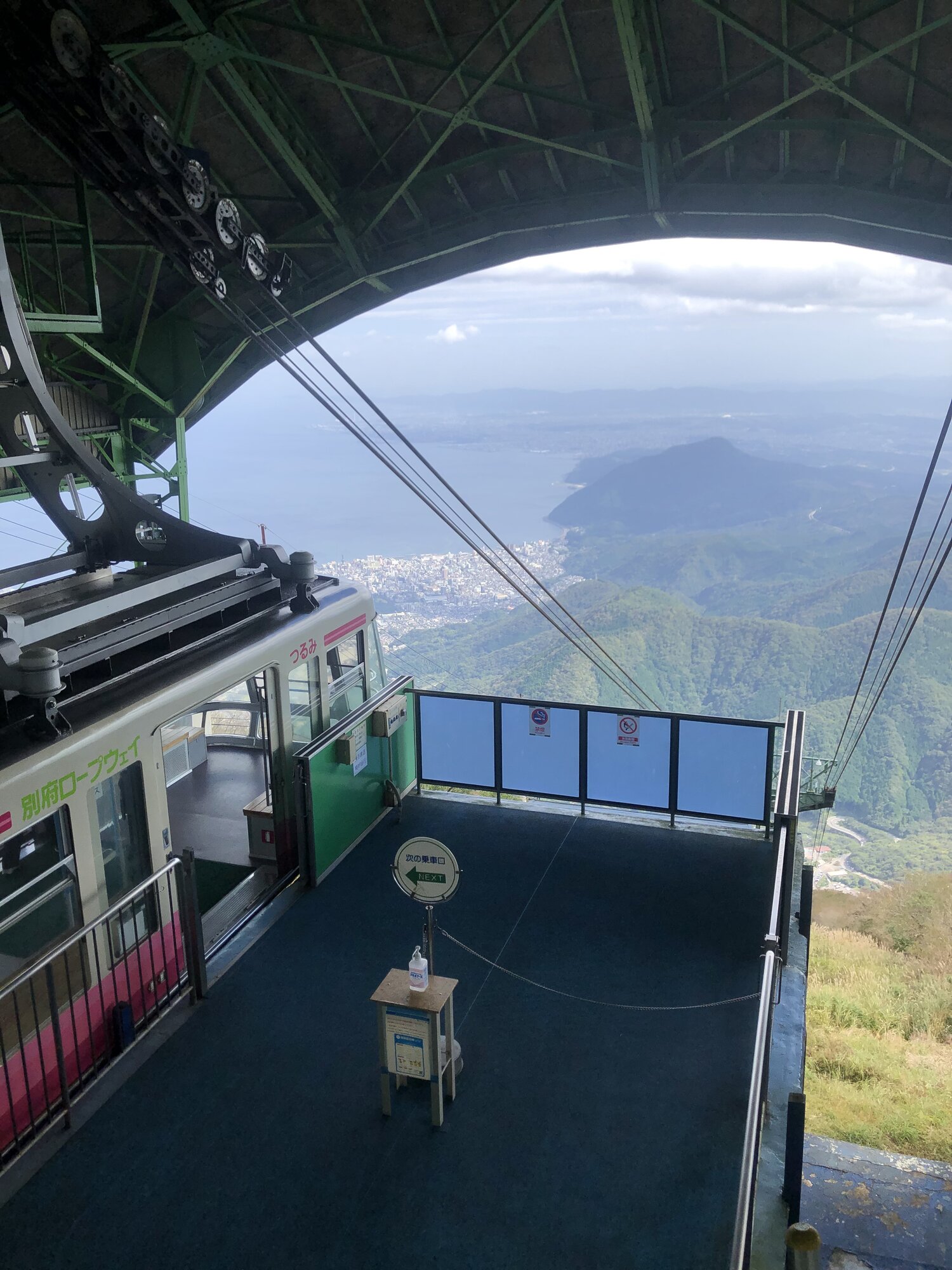
The Beppu Ropeway has been running since December 1962, and it’s still Kyushu’s largest-capacity cable car: two cabins, each holding up to 101 passengers, gliding along a 1,816m line that climbs 792.5m in about ten minutes, at a maximum gradient over 33°. The two gondolas were repainted for the ropeway’s 50th anniversary in 2012 and now run under their own names — the blue car is “Yufu-go,” after Mt. Yufu visible from the summit, and the red car is “Tsurumi-go,” named for the mountain it climbs.
A Shrine at the Summit
Near the upper station stands a small shrine with a bright red torii, Tsurumi Sanjō Gongen Ichinomiya. It’s traditionally linked to Hōō-Home Jinja (火男火売神社), the mountain’s guardian shrine down in Beppu, reputedly founded in 771 CE, whose twin enshrined deities are said to represent Tsurumi’s two summit peaks. The exact historical relationship between the summit-station shrine and the main shrine below isn’t documented in any source we could verify, but the devotional connection is well established locally, and the little red gate against the ridge and open sky is one of the most photographed things up here.

The View Over Beppu Bay
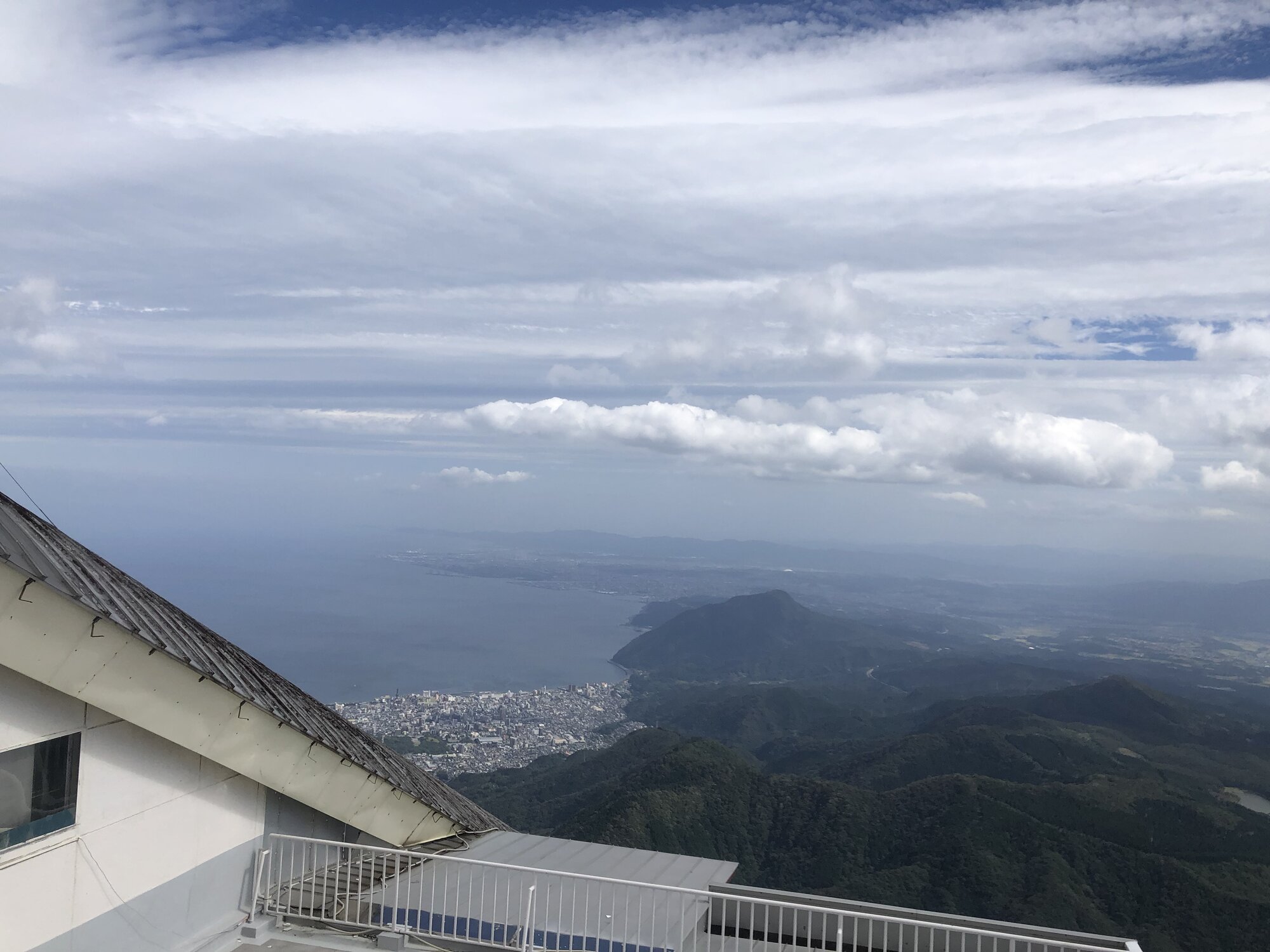
From the observation decks around the upper station, the view opens out east over Beppu city and Beppu Bay, south toward the Jōjima Highlands, and west to the near cone of Mt. Yufu with the Kuju mountains further behind it. On a very clear day, it’s said you can make out Shikoku across the water — we can’t independently confirm that claim beyond it being commonly repeated, but the sightline across the Bungo Channel makes it plausible. Either way, the city-and-bay panorama alone is worth the ride.
Walking the Summit Ridge
From the ropeway station, a short trail follows the ridge out to the true summit, where a stone marker reads “鶴見岳 頂上 1,375m” next to a large telecom relay tower (not open to the public). It’s an easy, mostly flat walk — no technical hiking required, just comfortable shoes — and the ridge itself, with its wind-bent trees and open grassland, feels a world away from the crowds at the ropeway platform a few minutes back.

Still an Active Volcano
Mt. Tsurumi is officially classified by the Japan Meteorological Agency as an active volcano, monitored jointly with the adjacent Mt. Garandake as a single volcanic complex (JMA volcano #513) — the same volcanic system that feeds Tsukahara Onsen’s fumarole field nearby. Its last confirmed eruption was a phreatic (steam-driven) event in 867 CE, with minor fumarolic activity recorded a few times since, most recently in 1995. As of our research, the alert level sits at the lowest tier (Level 1, “normal”), following a brief earthquake swarm in August 2026 that JMA confirmed had settled with no sign of heightened activity. None of this affects a normal visit — the ropeway and trails operate as usual — but it’s part of what makes the mountain interesting: a genuinely active volcano you can ride a cable car to the top of.
Golden Susuki in Autumn
If you visit in autumn, the boardwalk trails near the summit run through hillsides of susuki (Japanese pampas grass) gone gold and silver in the wind, with Beppu Bay laid out below. We don’t have a confirmed exact season for peak susuki at Tsurumi specifically, but based on typical timing for Kyushu’s volcanic highlands, expect the best of it sometime in the October–November range — worth checking closer to your visit if the grass is the main draw. Beyond susuki season, the mountain has its own smaller calendar of moments: Miyama Kirishima azaleas bloom on the upper slopes from mid-May into early June, rare-for-Kyushu rime ice can form on the ridge in winter, and the ropeway runs special early service on New Year’s Day for the first sunrise of the year.

For Hikers: Sea Level to Summit
The ropeway isn’t the only way up. A real hiking trail climbs from near Hōō-Home Jinja’s mid-mountain shrine to the summit in roughly 80 minutes up and 75 minutes down (about 5.9km round trip) — a legitimate, moderately steep hike for anyone who’d rather walk than ride. Once a year, on the second Sunday of April, the mountain hosts the Beppu Tsurumidake Ikki Tozan Taikai, a race climbing from sea level all the way to the 1,375m summit — billed locally as the only race of its kind in Japan, a claim we could only trace to a single source but which is a fun detail regardless.
Visiting Mount Tsurumi
Cost: Adult round-trip ¥1,800 / one-way ¥1,200; child round-trip ¥900 / one-way ¥600
Hours: Mar 15–Nov 14: 9:00–17:30 (last ascent 17:00); Nov 15–Mar 14: 9:00–17:00 (last ascent 16:30); operates year-round
Caution: The ropeway can suspend service in high wind or bad weather — check ahead on stormy days
Ride time: About 10 minutes, climbing 792.5m over a 1,816m line
Parking: Free parking at the base station (Beppu-Kogen Station)
Getting There
The ropeway’s base station is reachable by Kamenoi Bus (around route 36) from Beppu Station’s West Exit, about 20 minutes, or by car via free parking at the base station. If you’re driving yourself around Kyushu, see our guide to the Yamanami Highway and why you need a car for IDP and rental car basics.
Leave a Reply