This post contains affiliate links. If you book a rental car or tour through one of them, we may earn a small commission at no extra cost to you.
Most hot springs in this part of Oita ask you to imagine the volcano underneath them. Tsukahara Onsen just shows it to you. The bathhouse sits on the flank of Mt. Garandake (伽藍岳), an active volcano the Japan Meteorological Agency still monitors, and a short walk from the baths takes you straight into a field of bare, sulfur-stained rock with real fumaroles hissing steam into the air. It’s one of the more dramatic settings for a bath we’ve come across in Kyushu.
An Onsen With a Legend Attached
An on-site sign tells the story the bathhouse itself publishes: in the 12th century, the Heian-era warrior Minamoto no Tametomo (源為朝) was hunting on the mountain when he saw a wounded deer soaking in a pool of water here, healing its injuries — and that’s supposedly how the spring was discovered. It’s a good story, and it’s worth knowing it’s also a very common one: origin legends involving an injured animal discovering a hot spring show up attached to dozens of onsen all over Japan, and Tametomo specifically has founding legends tied to his name in well over a hundred locations nationwide. Treat it as local color rather than settled history.

The same sign makes some specific claims about the water itself: that its acidity ranks 2nd highest in Japan, its aluminum ion content 2nd highest, and its iron ion content 1st highest, and that it’s known as one of “Japan’s three great medicinal hot springs.” We looked into this, and it’s worth a caveat — the more commonly cited “three great medicinal springs” grouping in Japan is actually Matsunoyama, Arima, and Kusatsu, not Tsukahara. What Tsukahara’s own materials describe more precisely elsewhere is being one of three great acidic springs alongside Tamagawa Onsen in Akita and Zaō Onsen in Yamagata, which is a narrower and more defensible claim. The specific mineral rankings all trace back to the onsen’s own water analysis rather than an independent national database, so take the superlatives as advertised-but-unverified rather than confirmed fact. What isn’t in doubt: this is a genuinely strong, acidic spring, and it stings if you’ve got any cuts or scrapes.

Walking Into the Crater Field
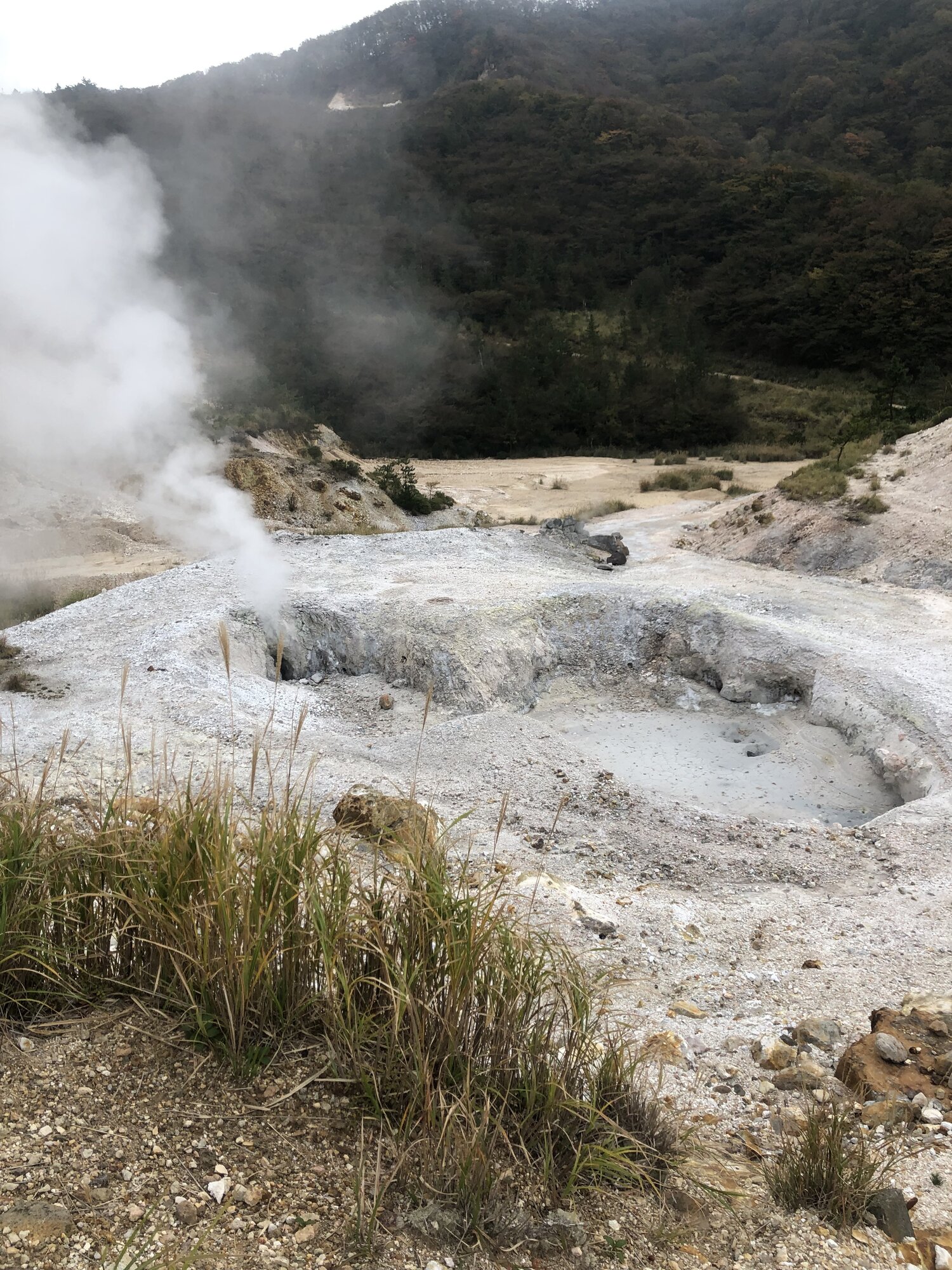
What makes Tsukahara different from a typical mountain onsen is what’s directly behind it. A short walking path leads from near the reception building up into an active fumarole field on Garandake’s slope — bare, bleached-white ground streaked with sulfur, steam vents roaring quietly out of cracks in the rock, and a barren, moon-like landscape that the bathhouse itself calls a viewing walk (crater viewing costs a small additional fee on top of bathing). It’s the same volcanic system that feeds the baths: the acidic, mineral-heavy water comes from this crater area. Locals sometimes call it a jigoku (地獄, “hell”), the same word used for Beppu’s famous hot-spring “hells,” even though it isn’t part of Beppu’s official hell-viewing circuit.

If you want to go further, the same trailhead is also the starting point for an actual hike up Garandake — routes range from a roughly 2.5-hour round trip to the western peak up to a longer 5-hour loop that also takes in neighboring Takahira-yama. We didn’t do the full hike ourselves, just the short crater-viewing walk, but it’s there if you want more.
A Soft-Serve Reward
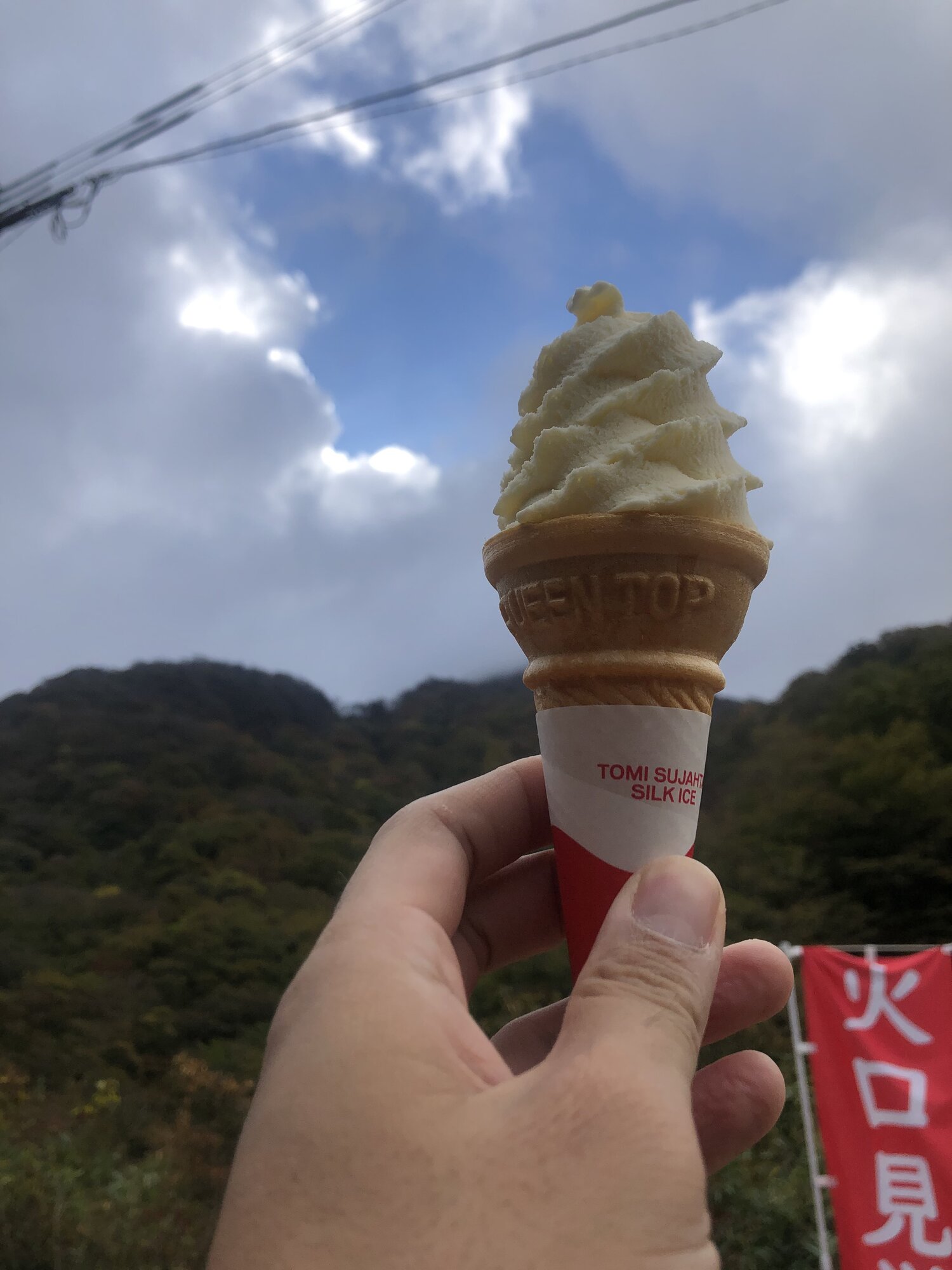
After the bath (and the sulfur smell that lingers pleasantly on your skin for a while afterward), there’s a small stand near the parking area selling soft-serve ice cream branded for the “crater viewing” (火口見) experience — a simple, well-earned reward with a view back toward the mountain.
Visiting Tsukahara Onsen
Address: 1235 Tsukahara, Yufuin-machi, Yufu City, Oita
Bathing: Gender-separated (not mixed) — indoor and outdoor baths per gender, plus private family baths
Cost: Indoor bath ~¥500 adult / ¥200 child; outdoor bath ~¥600 adult / ¥200 child; private family bath ~¥2,000 per 60 min; crater viewing ~¥200 adult / ¥100 child extra
Hours: Roughly 9:00–18:00 in summer, 10:00–17:30 in winter (seasonal — check the official site before you go)
Parking: On-site lot (~60 spaces); can fill by mid-morning on busy days
Access: Car only — no train or regular bus service reaches it. About 20 minutes from central Yufuin, or ~5 minutes from Yufu Interchange
This pairs naturally with a same-day stop at Yufugawa Ravine, a walkable slot canyon a short drive away — that’s exactly how we visited both.
Getting There
Tsukahara Onsen sits up a narrow mountain road on the slopes of Mt. Garandake, between Yufuin and Beppu. There’s no public transit option that gets you there directly, so a rental car is essential — see our guide to the Yamanami Highway and why you need a car for IDP and rental car basics.
Leave a Reply